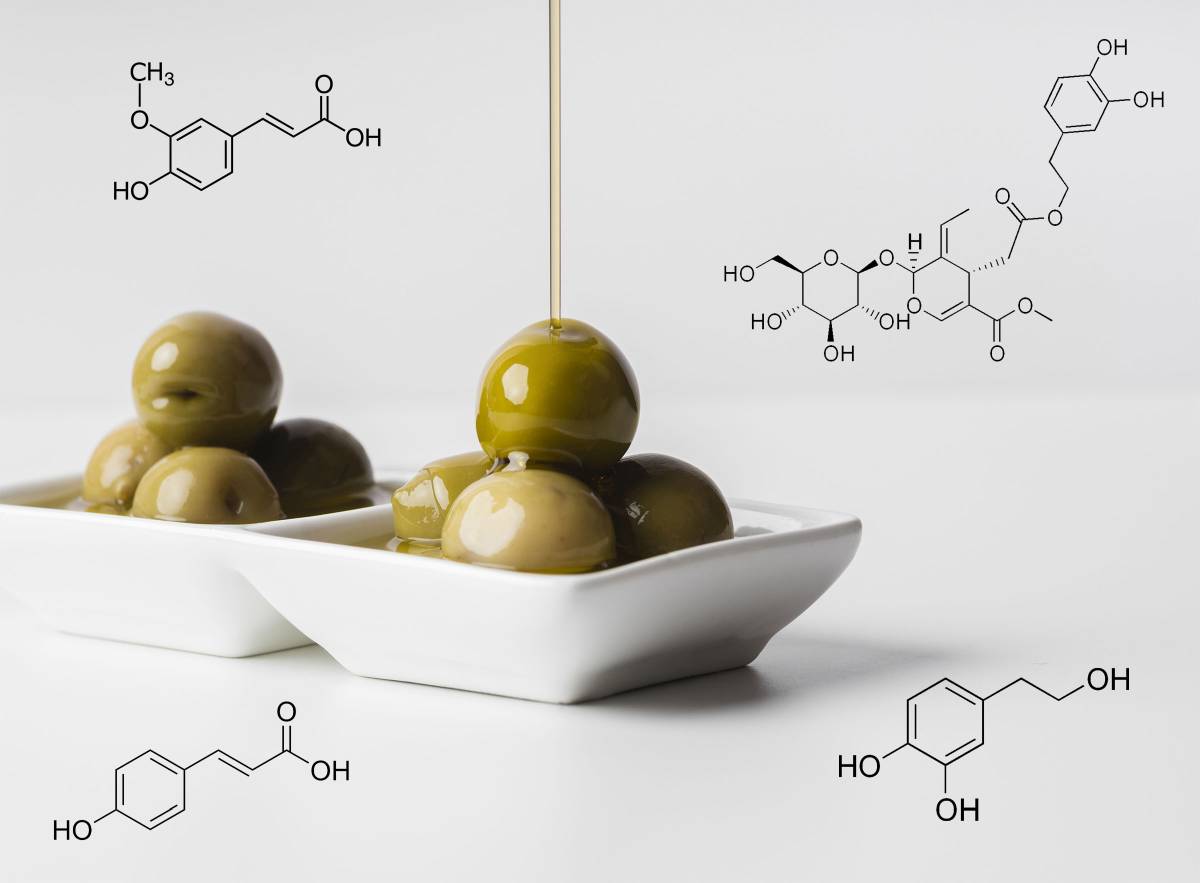
Chemical Composition of Olives
The main components of olive flesh are water, oil, sugars, proteins,
pectins, organic acids, tannins, aleuropein and inorganic components. The composition
of the olive varies according to the variety, the cultivation area, the year and the
development stage. This is why some olives contain a small percentage of olive oil
and a large percentage of sugars, as is the case with large-fruited varieties, and usually
they are used for eating. On the contrary, the small-fruited varieties contain more
percentage of olive oil and for this they are intended for oiling.
Moisture
Moisture is the most important component of fresh fruit. The moisture in the mesocarp
fluctuates
in a percentage of 50-70% and in the core 8-16% of the weight of the core. The lower the
percentage of moisture in the mesocarp, the higher the nutritional value.
Dissolved in the water of the cellular juice are sugars, eleuropein,
organic acids, tannins and other cellular components. The moisture contained in the fruit
is responsible for its non-shrinkage under extreme conditions. The percentage of humidity
depends on the harvesting period of the olive fruit, i.e. on its ripening and if the
arable land is dry or irrigated. During the processing of the fruit
moisture decreases.
Fatty Substances
Low oil content is considered an advantage for the table olive. The oil content
of the fresh fruit of table olives ranges from 18-30% mainly in the mesocarp while
small amount is found in the endocarp at about 0.8% of the weight of the kernel. The fatty
ones
substances, being non-polar, are not extracted into the brine. Thus the fat content of the
fruit at the end of
processing is the same as that of the raw material or slightly increased. This increase is
virtual and is usually due to the loss of other water-soluble components of the flesh. The
main fatty acids contained are oleic, linoleic, linoleic,
palmitic and stearic, their ratio changes during ripening.
Percentages of oil content may differ even in fruits derived from
same tree.
Sugars
Sugars such as glucose, fructose, mannose, galactose, sucrose and xylose
are present in the olive fruit. The main ones are fructose and glucose which make up the
90-95% of sugars. The green fruit of the Cannervolia variety contains only 2 grams of
reductant
sugars (glucose, fructose) per 100 grams of fresh weight. Experimental fermentations of
of the Kalamon variety report reducing sugars of 1.6 grams per 100 grams of fresh weight.
The corresponding measurements for the main Spanish varieties Gordal and Manzanilla are
6 and 3 grams, respectively per 100 grams of fresh weight.
The sugars and oil in the olive fruit are inversely related. In industrial practice
it has been shown that the higher the content of fermentable components in the
mesocarp, the easier the olive ferments but also is preserved during the storage stages and
trading.
Proteins
The olive fruit of all table olives contains a small percentage of proteins. In particular,
the
Canned green olive was found to contain 1.38% crude protein. The percentage of
of proteins on a fresh basis in Spanish table olives of different varieties and
of different processing ranges from 0.72-1.42%. Despite their small percentage, the
olive proteins are important because in the structure of their molecules,
essential amino acids for human nutrition are involved. In the same study it was found
that among the amino acids of olive proteins, the predominant ones are glutamate,
aspartic acid followed by the basic amino acids valine, leucine, arginine, tyrosine,
phenylalanine, alanine, lysine, glycine. The protein that is extracted into the brine
supports
the growth of lactobacilli. Therefore, the amino acids of proteins are important
for the smooth progress of the lactic acid fermentation of the natural black olive.
Vitamins
Vitamins are divided into water-soluble vitamins, which include vitamins C, B1, B2 and B6
and oil-soluble to which belong the precursors of vitamin A and
Vitamin E (tocopherols). Table olives are rich in tocopherols and tocotrienols.
These substances play an important role in antioxidant mechanisms of the
human body.
Vitamins can be increased by microbial activity during olive fermentation.
During the processing of the table olive, the water-soluble vitamins are lost, while
the fat soluble remain. Generally the olive fruit is not considered as a good source
of vitamins for human nutrition, but together with the other valuable ingredients it
contains certain amounts of vitamins with special nutritional value for humans.
Pectins – Pectinolytic enzymes
Pectin participates in building the cell wall and occupies the
space between two adjacent cells known as the middle lamella. The
pectins are macromolecules which may cross-link with the intervention
divalent cations, such as calcium, making the flesh of the olive becomes more cohesive.
Immersion of the olives in a bath containing calcium chloride
for a few hours increases the cohesiveness of the flesh. Its pectin content in the
mesocarp of the olive is about 2% of fresh weight expressed in anhydrous form of
galacturonic acid. As the ripening of the olive fruit progresses, the
protopectin and total pectins are being reduced. With the reduction of protopectin the flesh
become
softer and soluble pectin is increased progressively. The degradation of protopectin,
by any means, results in a soft texture.
The pectinolytic enzymes that interest the table olive belong to two
categories: in esterases (pectinesterases, methylesterases, etc.) and in
polygalacturonases (endo-, exo-polygalacturonases, etc.). The first ones break up
the ester bonds and release methanol and the latter cleave the 1,4-a
glycosidic bond and release galacturonic acid molecules or dimers, trimers,
derivatives.
Polyphenols–Tannins
The phenolic substances that have been isolated from time to time from the olive fruit are:
ligustroside, hydroxyphenylethanol, eleuropein, glycosylated
oleanolic acid, dimethyl-eleuropein, the isomer securidoide, oleoside,
verbaxide and caffeic acid.
Phenolic substances are responsible for the appearance of bruises in the raw material,
of either green or black olives. In the first case the bruises remain
after fermentation while in black olives in the places where the olive was bruised it is
softer when fermented. The olive fruit is rich in polyphenols. The polyphenols in
alkaline environment oxidize and give an artificial black color. The color is due to
polymerization of polyphenols, including eleuropein.
Greek table olives have phenolic substances from 0.29-2.3 mg per 100 grams of gallic acid.
Eleuropein
Eleuropein belongs to the phenolic substances, it is found in all the tissues
and mainly in the mesocarp of the olive. It is a polar substance and therefore
water-soluble, so that it is extracted with the water or brine from the flesh along with
other water-soluble substances. In addition, it is an inhibitor of lactic fermentation. It
is responsible for the bitter taste of the olive fruit and for this reason it should be
partially or completely removed, depending on the variety of olive.
The antimicrobial effect of eleuropein in the growth of pathogens and the growth of
toxin-producing fungi is important. Eleuropein is obstracting
the growth and production of
enterotoxin B of Staphylococcus aureus and Salmonella enteriditis. It also has
antimicrobial activity on vegetation and
growth of Bacillus cereus spores. In addition, Eleuropein is completely obstracting
the growth of Escherichia coli.
Pigments
The pigments of the fruit are of particular importance for its industry
table olives, despite the fact that they have no nutritional value for humans.
However, in the table olive, as in other foods, the color is the main thing
determinant of quality. Olive pigments are divided into two
categories: in the fat-soluble ones which are chlorophylls and carotenes, and in
water-soluble which are mainly anthocyanins. Chlorophylls are synthesized in the former
stages of fruit development and gradually recede over ripening
to be replaced initially by carotenes (yellow color) and finally by
anthocyanins at the stage of partial or full ripening (color pink, violet,
melanovirus, black).